Vyan

Showing posts with label Ibn Sheik al-Libi. Show all posts

Thursday, December 21

Rebutting the Defense Against the Impeachement of George W. Bush

As would be appropriate in an actual Impeachment Trial - Major Danby has posted a "Defense Against Impeachment" arguement that is quite thorough and cogent as should be expected in any case of this level of seriousness.

I never had any expection that Impeachment would be easy, if I beleived so I wouldn't have started writing the series - I felt that we needed a "roadmap" to pull most of the issues as we understand them now, before the 110th Congress begins it's investigations.

In this diary I take my turn providing a Prosecutorial Rebutal to the arguements of the Defense in order to bring the series to an appropriate close.

Let The Court of Truth be Now in Session. You are now the Jury.

Opening Statement by the Defense.

The overarching observation I begin with is that you impeach a person, not an administration. Every attempt at Presidential impeachment (and to my knowledge, all others) begins with the President voluntarily taking an action that he knew or should have known was wrong.

* Andrew Johnson intentionally provoked a Constitutional Crisis by firing Sec. Seward in contravention of the Tenure in Office Act, which he believed was unconstitutional. (Rightly, the Supreme Court later held.)
* Richard Nixon intentionally ordered that hush money be paid for people who had committed a burglary and committed espionage on behalf of his campaign.
* Bill Clinton was intentionally misleading (if not actually lying) under oath in his deposition regarding a civil case in which he was a defendant. (Yes, what he did wasn't technically illegal -- and to my mind not nearly impeachable -- but there was no doubt that he knew the truth and intended to conceal it for his own gain.)


I clearly agree the Impeachment relates to individuals, not an entire Administration - however what I was alluding to through-out my entire Impeachment Series was the fact that Congress has to be ability to not only Impeach the President, they can also Impeach the Vice-President or members of the Cabinet.

On the issue what a potential Impeachment target "should have known" - I do not agree that President Clinton should have known that his unwillingness to divulge information that he wasn't really asked - was "wrong". A lifetime ago I wrote my own rebuttal to the Starr Report. The Charges against Clinton were based on Perjury, Witness Tampering and Obstruction of Justice.

Allegation #2 reads as follows:

In his civil deposition, to support his false statement about the sexual relationship, President Clinton also lied under oath about being alone with Ms. Lewinsky and about the many gifts exchanged between Ms. Lewinsky and him.


The primary problem with this allegation was the Clinton didn't claim he wasn't ever alone with Monica Lewinsky - he admitted that he was and gave examples of when that could have occured such as

"A... when she worked at the legislative affairs office, they always had somebody there on the weekends. I typically worked some on the weekends. Sometimes they'd bring me things on the weekends. She – it seems to me she brought things to me once or twice on the weekends."

Q. So I understand, your testimony is that it was possible, then, that you were alone with her, but you have no specific recollection of that ever happening?

A. Yes, that's correct. It's possible that she, in, while she was working there, brought something to me and that at the time she brought it to me, she was the only person there. That's possible.


Certainly there was more to the story, the problem is that the they didn't ask him about it during the Jones deposition. His failure to volunteer additional information that he wasn't asked is not a "wrong" act on his behalf.

Back to the current President, almost.

So I take it as a given that we need to find similar personal knowledge, in advance of a crime, on Bush's part. Otherwise we may end up in the situation that we did with Iran-Contra where the investigation could not show that Reagan himself ever quite connected the dots -- due to his own incuriousity and feeble thinking -- to see that actions he ordered (or at least acquiesced to) were illegal. And that didn't work out so well.


In Iran-Contra many of the subordinates involved chose to "fall on the sword" and protect the President through plausible deniability and by lying to Congress. But Reagan did eventually admit wrong-doing.

Reagan's admission in March 1987 that "it was a mistake" to trade weapons for hostages was what saved his reputation, according to Cannon.

Reagan said at the time, "A few months ago, I told the American people I did not trade arms for hostages. My heart and my best intentions still tell me that is true, but the facts and the evidence tell me it is not."


As far as I'm concerned Iran-Contra worked out fine - because it resulted in changing the President's behavior and sending several criminals to jail, at least until Federalist Society Judges overturned the various perjury and contempt of Congress convictions that had been given to various Reagan Administration Officials.

Anyway, enough digression.

>Count 1 Intelligence Fraud

The minimum requirements for fraud are that you (1) intentionally (2) represent to someone else (3) that something is true, (4) when it is not true and (5) when you know is not true, intending that (6) they will take some action (7) that benefits you.

1. PNAC wanted to "invade." Arguably relevant to "motive," but "motive" isn't at issue here.

2. Bush said he wanted to invade Iraq "if I have the chance." Pretty much irrelevant to impeachment. The question is whether he did it by illegal means. If I want a Mercedes, and later you see me driving one, that doesn't mean that I stole it.


Actually "motive" is at issue here - since it statisfies requirement (7). In this case the benefit that Bush would have received by invading Iraq is exactly as he stated - he stated that he would gain political capital, and be better able to implement his legislative agenda.

3. About yellowcake: (a) Bush never said that the yellowcake story was true, but that the British government believed it to be true (so element (3) of the crime is not satisfied);


It's clear that by mentioning the issue during his state of the union Bush was expressing that he believed the story, not what the British Government believed. If he believe something different from what the British believed - it was incumbent upon him to make the distinction. He did not, instead he said:

The British government has learned that Saddam Hussein recently sought significant quantities of uranium from Africa.


This is not a statement of what the British government believed, "Saddam Hussein recently sought significant quantities of uranium from Africa" is stated as a fact, not an opinion of the British. Add to that his statments during the Cincinnati speech.

The evidence indicates that Iraq is reconstituting its nuclear weapons program. Saddam Hussein has held numerous meetings with Iraqi nuclear scientists, a group he calls his "nuclear mujahideen" -- his nuclear holy warriors. Satellite photographs reveal that Iraq is rebuilding facilities at sites that have been part of its nuclear program in the past. Iraq has attempted to purchase high-strength aluminum tubes and other equipment needed for gas centrifuges, which are used to enrich uranium for nuclear weapons.

If the Iraqi regime is able to produce, buy, or steal an amount of highly enriched uranium a little larger than a single softball, it could have a nuclear weapon in less than a year. And if we allow that to happen, a terrible line would be crossed. Saddam Hussein would be in a position to blackmail anyone who opposes his aggression. He would be in a position to dominate the Middle East. He would be in a position to threaten America. And Saddam Hussein would be in a position to pass nuclear technology to terrorists.


He would be - Kim Jong-Il?

None of these statements were true, and there was ample information available in the State Dept, Energy Dept, IAEA, CIA and DIA to refute all of it prior to October 2002. Further the NIE stated that the Niger claim was "highly dubious" and as a result references to it were removed from the Cincinnati speech, it also said it was highly unlikely that even if Saddam Hussein possesed WMD's that he would use them unless he was provoked. So naturally, Bush provoked him.

(b) the questionable acts described are those of his advisors -- note where Vyan quotes people saying "*they* put it back in, they preferred to perpetuate a lie" (so element (1) isn't satisfied, and remember that you can't impeach the administration, just the man);


As stated above, you can Impeachment individual members of the Administration. In this case the target(s) - exempting those who've already resigned - would be Cheney and members of his staff such as Scooter Libby, Stephan Hadley and Donald Rumsfeld who were all heavily involved in what Wilkerson describes as "The Cabal".

The ultimate question though is whether Bush himself was a willing member of the "Cabal" or simply improperly served by those beneath him. I think the answer to this is found in several places.

Bush was personally briefed by George Tenet and chose to ignore the information provided by Iraqi Foreign Minister Naji Sabri - that Iraq no longer had WMD in September of 2002. This was before the Cincinnati speech, before the passage of the Iraq Force Resolution and cleary before the 2003 SOTU.

European CIA Chief Tyler Drumheller was told "Well, this isn't about intel anymore. This is about regime change.'"

From the Downing Street Minutes from July of 2002.

C reported on his recent talks in Washington. There was a perceptible shift in attitude. Military action was now seen as inevitable. Bush wanted to remove Saddam, through military action, justified by the conjunction of terrorism and WMD. But the intelligence and facts were being fixed around the policy. The NSC had no patience with the UN route, and no enthusiasm for publishing material on the Iraqi regime's record. There was little discussion in Washington of the aftermath after military action.


And Downing Street II.

A memo of a two-hour meeting between the two leaders at the White House on January 31 2003 - nearly two months before the invasion - reveals that Mr Bush made it clear the US intended to invade whether or not there was a second UN resolution and even if UN inspectors found no evidence of a banned Iraqi weapons programme.


And speaking of manufacturing a fraud...

Mr Bush told Mr Blair that the US was so worried about the failure to find hard evidence against Saddam that it thought of "flying U2 reconnaissance aircraft planes with fighter cover over Iraq, painted in UN colours". Mr Bush added: "If Saddam fired on them, he would be in breach [of UN resolutions]".


Defense Continued...

(3) so there's no evidence on record to show that Bush himself did not believe the story to be true or, more to the point, that he believed it was not true (as opposed to, say, mostly but not entirely proven) based on his advisors' representations, (so element (5) of the crime is not met).


According to the record he didn't care whether it was true or not. Bush was willing to paint as US plane as if it was a from UN on the hopes that Saddam would fire on it and prove that he had broken UN sanctions. That suggestion statisfies all 7 elements of criminal fraud right there. According to Downing Street - the policy had already been set in July of 2002, long before the President's State of the Union or Colin Powell's UN speech. From that point foward it was a matter of "selling the war" - not finding out the truth.

4. Most of the other things "they" did or didn't know do not refer to Bush's own demonstrated knowledge; nor does the fact that any of these turned out not to be true, or that with hindsight turned out to be based on a weak premise, prove that the proponents of the information knew that it was false. Did the CIA say otherwise?


Yes they did, the NIE said that Saddam was unlikely to use WMD even if he had them according to Senator Bob Graham - who along with Sen. Durbin has requested the NIE in the first place.

There were troubling aspects to this 90-page document. While slanted toward the conclusion that Hussein possessed weapons of mass destruction stored or produced at 550 sites, it contained vigorous dissents on key parts of the information, especially by the departments of State and Energy. Particular skepticism was raised about aluminum tubes that were offered as evidence Iraq was reconstituting its nuclear program. As to Hussein's will to use whatever weapons he might have, the estimate indicated he would not do so [use WMD's] unless he was first attacked.

...

Under questioning, Tenet added that the information in the NIE had not been independently verified by an operative responsible to the United States. In fact, no such person was inside Iraq. Most of the alleged intelligence came from Iraqi exiles or third countries, all of which had an interest in the United States' removing Hussein, by force if necessary.


Continued...

All Bush has to say is that he didn't fully trust the CIA's position. If he knew that they were anti-war, he would have had reason for skepticism. Most of the stuff dealing with Powell, etc., doesn't implicate Bush's knowledge.


This suggests facts not in evidence.

5. Bush's 2003 SOTU can be defended against constituting fraud. When Bush said "This is a regime that agreed to international inspections -- then kicked out the inspectors," this is not literally untrue (element (4) not satisfied), though it's misleading as hell; as Vyan's diary shows, Saddam did kick out "the" inspectors, if by that one means American inspectors (a misleading but permissible construction) in 1997.


Misleading but technically true statements are permissible? - You mean like "It depends on the what the meaning of "Is" is?" or "I did not have 'sexual relations' with that woman, Ms. Lewinsky?"

In both of these cases, Bill Clinton was telling the truth as he saw it. "There is no relationship" depended on whether one of Clinton's attorneys was speaking in present tense or past tense. What Clinton was saying was the statement was true in present tense, and false in past tense. He was admitting that had been a relationship, but it was over at that time. In this case, he was actually admitting something against his own interests - that his lawyer might have been lying.

The definition of 'sexual relations' was not something Clinton made up, it was a very specific list of items provided by the Jones attorneys, and in Clinton's judgement he didn't do anything on the list - Monica did. They never asked him what Monica did.

Yet again, misleading - true - but permissible? Not hardly according to existing precedent.

By contrast Bush did not claim that the Saddam kicked out the American inspectors, he clearly implied that he'd kicked out all the inspectors and that simply isn't true. If he'd said "some" it might have been closer to the truth.

His counsel will argue that even if that was misleading, it didn't matter, because Bush did believe that Saddam posed a serious danger and possessed WMDs and the additional puffery he ladled on to help make the political case for war doesn't constitute fraud. As for the fact that Saddam didn't violate the agreement -- if Saddam thought that he has a chemical and bio weapons program, then we certainly can't say that Bush knew for certain that he did not (element (5) unsatisfied.)


Saddam knew full well that he had no chemical weapons since he'd ordered them destroyed in 1991. He actually announced this fact to his own Generals three months before the war.

So then we get to the crux of Vyan's argument in point 1:

If Bush didn't know what he was claiming were complete falsehoods - he should have known. It's HIS JOB TO KNOW. Whether he personally initiated the fraud isn't the point, he helped perpetrate it. He legitimized it. He is the one ultimately responsible.

No. That is simply not the law of fraud, absent specific statutory language (such as you may see in some Sarbanes-Oxley requirements) to the contrary. Here's a perfectly good defense against fraud: Bush relief on the advice of competent advisors, the most senior of which were approved by the Senate, in these areas, and he believed in good faith that Saddam had at least some WMDs and therefore posed a threat to the U.S. It is not "his job to know"; it's his job to take the information he has, form an opinion, and promote a policy that is not, to his knowledge, opposed to the facts.


The record shows, including the NIE, that Bush had been told by several competent advisors - who had been approved by the Senate such as George Tenet - that there was significant doubt regarding Saddam's WMD status.

The reason I say that it was Bush's "job to know" isn't based on the law of fraud - it's based on the Presidential Determination section of HJ 141, which like Sarbanes-Oxley did include very specific requirements for the President to meet prior to using force against Iraq.

(b) PRESIDENTIAL DETERMINATION.

In connection with the exercise of the authority granted in subsection (a) to use force the President shall, prior to such exercise or as soon there after as may be feasible, but no later than 48 hours after exercising such authority, make available to the Speaker of the House of Representatives and the President pro tempore of the Senate his determination that

(1) reliance by the United States on further diplomatic or other peaceful means alone either (A) will not adequately protect the national security of the United States against the continuing threat posed by Iraq or (B) is not likely to lead to enforcement of all relevant United Nations Security Council resolutions regarding Iraq, and


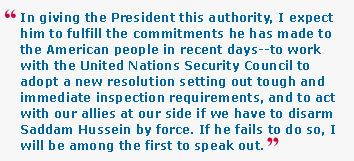
The President was required by the Iraq Force Resolution itself to report to Congress his determination that further attempts at diplomacy would not be effective at protecting the United States from Saddam Hussein. The core of my fraud charge is based on this point - the President was required to prove that Saddam was a imminent threat, he was required to know by the resolution he himself had signed in October of 2002, but according the Downing Street Minutes (with various levels cooberation) Bush and his Administration were already commited to regime change regardless of the facts at least as early as the previous July.

Yet Saddam Hussein had told us and the UN that he was disarmed in December. The President was required to verify that disclosure, but instead he chose to ignore it, and the weapons inspectors who said our WMD intel was garbage and invade.

I submit that there is no reasonable way that document delivered to Congress to justify the use of force against Iraq under the requirements of HJ 141 could not have been fraudulent.

Count 2 Domestic Spying.

1. Let's start by dispensing with the Constitutional argument. There is already no warrant needed. You can get authorization for a warrant after a call -- it's now three days; the Democratic Congress wants to make it a whole week. No one is still challenging the fact that you don't need a warrant in advance for surveillance. For "chasing down terrorists" -- as Vyan quotes the President -- then you do. But then we have probable cause, thanks to this surveillance -- a program that is highly supported by the American people, unlike, say, paying hush money or lying during depositions.


The issues isn't whether you need a warrant in "advance" of doing listening - it's whether you need a warrant and any judicial oversight to verify that probable cause has been met ever. The President's position is now that he doesn't need to meet probable cause and doesn't need to secure a warrant at all, which is clearly extra-constitutional.

And I wouldn't say the program is "Highly supported".

"As you may know, the Bush Administration has been wiretapping telephone conversations between U.S. citizens living in the United States and suspected terrorists living in other countries without getting a court order allowing it to do so. Do you think the Bush Administration was right or wrong in wiretapping these conversations without obtaining a court order?"

9/15-17/06 Right 55% Wrong 45% Unsure 3%


2. FISA doesn't intend to tie the President's hands during wartime. Congress never intended FISA to prevent the Administration from defending against direct attack on the United States.


And truth be told, the President hands would not be "tied" if he were to simply use FISA as it currently exists to obtain surveillance warrants. The existing three-day grace period guarantees this.

3. If FISA does do so, it's an unconstitutional encroachment on the President's powers as the unitary executive. During wartime, the constitution demands deference to the President's authority as Commander-in-chief. Etc. If the unitary executive model is correct, then the President's actions are proper. "If the President does it, it's not a crime," some guy once said.


No, the Constitution makes no such demand. The only change which is created by the existence of a war, is the option for the Congress to temporarily suspend Habeas Corpus - the Constitution does not grant the President any special dispensation or additional powers during wartime.

4. AUMF authorized these actions. [OK, I can't write much to support the argument, but they will make it and some will buy it.]


That has been debunked by Hamdi V Rumsfeld, which states that there is a "judicial role" to be played involving the handling of terrorists.

5. Much of what the Administration is accused of is not actual interception of the content of messages, but the equivalent of looking at the outsides of envelopes without opening them. This is legal.


If we were talking about the U.S. Mail - it would be, but we aren't. Tracking the "wrapper" of an email or phone call - without accessing the content - required the installation of a "Pen and Trap" or equivelent device similar to those which have been installed it would violate 18 USC § 3121.

(a) In General.— Except as provided in this section, no person may install or use a pen register or a trap and trace device without first obtaining a court order under section 3123 of this title or under the Foreign Intelligence Surveillance Act of 1978


Defense continued...

6. Most importantly, the President was relying on the advice of competent counsel, the leaders of which were approved by Congress, in all of these matters. It may be that the President's position was mistaken; Presidents win some court cases and lose them, but we don't talk about impeachment when they lose a case. (LBJ favored minority set-asides ruled unconstitutional in Adarand. Was his action impeachable?) Even if the President's actions were wrong here, he was acting on legal advice. To find an impeachable offense here, you have to include that not only was the advice he was given about FISA, the AUMF, and the unitary executive wrong, but that it was so obviously wrong that the President was unreasonable to accept it. The fact that the author of one such memo was approved by Congress to a lifetime appointment on the 9th Circuit Court of Appeals, and that another is a prominent professor at a leading law school, both positions being attained after their participation in these activities was known, shows that -- at worst -- the position was arguable. To say that the President risks impeachment for relying on the legal advice of counsel would weaken the Presidency irreparably. This is not the standard we would use when the penalty at issue was a mere fine, let alone the Presidency.


Well, if they could consider Clinton's attorney saying "There is no relationship" to be Impeachable - I think the bar has been signicantly lowered in this area.

However, I think again that the Supreme Court Hamdi decision where the Court required Judicial Review in relation to terrorist suspects and established that "War is not a Blank Check" for the President has largely eviscerated any legitimate argument supporting this program.

The fact the Gonzales and the DOJ continue to ignore this is a good argument for the Impeachment of Gonzales on malpractice grounds for giving advice to a client that knowingly precipitated and justified a criminal act.

>Count 3 War Crimes

(A) Vyan argues that the Gonzales Memo suggesting exempting Taliban fighters from the protection of Geneva is prima facie evidence of a crime, stating that "We Are Signatories and as such we are required to abide by Geneva." But this doesn't contradict the memo, In fact, Vyan himself quotes the relevant portion:

In addition to the provisions which shall be implemented in peace time, the present Convention shall apply to all cases of declared war or of any other armed conflict which may arise between two or more of the High Contracting Parties, even if the state of war is not recognized by one of them.


I've boldfaced the parts that Vyan did, but the critical section is what I've italicized: terrorists, including unrecognized governments, are not representatives or forces of states, and therefore they are not "High Contracting Parties" and the protections we have agreed to do not extend to them. Because of this mistake, Vyan raises a number of arguments related to treatment of "Prisoners of War" that are inapplicable to the Al Qaeda and Taliban fighters. They aren't Prisoner's of War because they aren't fighting for a Geneva signatory.


I did make a mistake, but not the one you claim. I didn't quote the right paragraph of the Conventions.

Although one of the Powers in conflict may not be a party to the present Convention, the Powers who are parties thereto shall remain bound by it in their mutual relations. They shall furthermore be bound by the Convention in relation to the said Power, if the latter accepts and applies the provisions thereof.


Any signatory or High Contracting Party to the Conventions is required to abide by the Convention in all cases, not simply when they are in armed conflict with another High Contracting Party.

I would also agree that Al Qaeda and Taliban fighters are not "Prisoners of War" under the Convention until they has been a competent tribunal to determine this on a case by case basis, and then prior to such a tribunal any persons captured by opposing forces are afforded the full protection of the conventions under Article 5.

Article 5

The present Convention shall apply to the persons referred to in Article 4 from the time they fall into the power of the enemy and until their final release and repatriation.

Should any doubt arise as to whether persons, having committed a belligerent act and having fallen into the hands of the enemy, belong to any of the categories enumerated in Article 4, such persons shall enjoy the protection of the present Convention until such time as their status has been determined by a competent tribunal.


Furthermore, Congress has implicitly if not explicitly accepted this in numerous of its acts, by both commission and omission. Should the President now be impeached for a "crime" that Congress has agreed up until now is not a crime based on a fair interpretation of Geneva?


The likelyhood of the Military Commissions Act passing Constitutional muster is extremely low, and partly why the restrictions on Habeas Corpus within the bill are so onerous. If - no when - the new Congress acts to restore Habeas and remove these restrictions this law is likely to fall into itself like a souffle. The fact that Congress repeated the President's error does not change the fact that it is a gross Constitutional error.

This issue was indeed the one where various members of the Bush Administration had the highest and most serious vulnerability, hence their urgency in utilizing the 109th Congress to provide legal cover for their actions with the MCA before the end of their term. For the time being they have "innoculated" themselves on this count.

(C) The Rumsfeld memo is subject to a similar analysis as the Bybee memo.


Possibly, pending a judgement on the matter from the Supreme Court or a repeal/amendment to the MCA.

(D) Extraordinary rendition fell within the power of the President under the theory of the Unitary Executive. Again, impeachment on this point means fighting that out.


Bring it.

(E) If Hamdan did make previous Bush Administration actions potential war crimes, the Military Commissions Act settled that they are not, and impeachment will take place after passage of the MCA, not before. Many of the Bush Administration's actions have been retroactively "cleansed" by a bipartisan vote and cannot serve as a basis for impeachment.


Agreed. As I said, they've been "innocolated" for the time being. Any future SCOTUS decision which overturns all or portions of the MCA will reopen this issue.

(F) Again, consider the "advice of counsel" defense. The President is entitled to rely on the advice of his competent counsel. Taking away that right would be a disaster. This means that you must show not simply that the President was wrong, but that the President was not reasonable in accepting this advice. That's a high bar to clear.


Going again back to the Clinton precedent, Ken Starr argued that Bill Clinton was engaging in Obstruction of Justice when he gave factually inaccurate information to his staff, including White House Counsel - even when there was no pending legal proceeding related to that issue, and none of the persons he was speaking with were on any witness list.

Essentially he was considered to be "under oath" at all times even in private conversations with his secretary Bettie Currie. The bar is already pretty darn low.

What I'm suggestion though is that there is no legal protection for an attorney who gives his client advice to specifically circumvent and break the law, and that is exactly what Gonzales and Bybee have done here. The charge is that their advice was knowingly false, and that it was requested specifically by the President in order to persue illegal activities.

Conclusive proof of this intent does not currently exist in the record, but sufficiently targeted Congressional subpeonas are IMO likely to discover quite a bit of information that we don't current have which just might resurrect this charge even while the MCA is still in effect.

I have presented a Count 4: Criminal Negligence - which was not included in the Defense argument, but for the sake my carpal tunnel - I'll leave that for another time.

Vyan

Sunday, December 17

The Impeachment Case Against George W. Bush - Count 3. War Crimes, Torture, Murder and Conspiracy

Musical Accompaniment for this post by Guns N Roses - "Live and Let Die"


The countdown to the start of the 110th Congress is growing shorter. Although Majority Leader Reid and Speaker Pelosi have put Impeachment "Off the table" - simply because at this point in time most of the American public would not support such a move, and would consider it merely partisan maneuvering as was the Impeachment of William Jefferson Clinton.

On this point I believe they are correct, thus the terms have to modified. Impeachment has to be seen as merely the first step toward the ultimate goal of Removal, Indictment and Prosecution of those who have committed crimes against our Constitution. Thus I present Count 3 in my multipart series on why George W. Bush must be Impeached.

The Impeachment Case Against George W. Bush - Count 3 : War Crimes, Conspiracy, Torture and Murder. George W. Bush, Dick Cheney, Alberto Gonzales and Donald Rumsfeld did commit a series of Capital Crimes with malice aforethought, including grave breaches in the Geneva Conventions and the Laws of War - actions which have led to numerous counts of maltreatment of prisoners and torture up to and including over multiple murders under color of authority

Exhibit A: The Gonzales Memo Following the attacks on the World Trade Center and Pentagon on 9/11 - America moved into a War Footing against Al-Qeada and Afghanistan. Congress passed the Authoritzation to Use Military Force, and our government began to grapple with the issue of how to handle captured prisoners and terrorist suspects.

On January 24, 2002 Alberto wrote a Memo (PDF) addressing this subject.

"It is difficult to predict the motives of prosecutors and independent counsels who may in the future decide to pursue unwarranted charges based on Section 2441 [the War Crimes Act]," Gonzales wrote. The best way to guard against such "unwarranted charges," the White House lawyer concluded, would be for President Bush to stick to his decision--then being strongly challenged by Secretary of State Powell-- to exempt the treatment of captured Al Qaeda and Taliban fighters from Geneva convention provisions.

"Your determination would create a reasonable basis in law that (the War Crimes Act) does not apply which would provide a solid defense to any future prosecution," Gonzales wrote.

Although many at the time claimed the the exception of Taliban and Al-Qeada fighters from Geneva was done because neither were signatories of Geneva, the truth is very different. First of all the fact that they aren't signatories is irrelevant - We Are Signatories and as such we are required to abide by Geneva.

Geneva Article 2

In addition to the provisions which shall be implemented in peace time, the present Convention shall apply to all cases of declared war or of any other armed conflict which may arise between two or more of the High Contracting Parties, even if the state of war is not recognized by one of them.

But as was shown from his memo Gonzales had a different concern altogether. He was worried that some "wacky" prosecutor might determine that the Administration had violated 18 USC 2441 - the War Crimes Act - which states.

(a) Offense.— Whoever, whether inside or outside the United States, commits a war crime, in any of the circumstances described in subsection (b), shall be fined under this title or imprisoned for life or any term of years, or both, and if death results to the victim, shall also be subject to the penalty of death.

(c) Definition.— As used in this section the term "war crime" means any conduct—

(1) defined as a grave breach in any of the international conventions signed at Geneva 12 August 1949, or any protocol to such convention to which the United States is a party;

(2) prohibited by Article 23, 25, 27, or 28 of the Annex to the Hague Convention IV, Respecting the Laws and Customs of War on Land, signed 18 October 1907;

The Conventions lay out specifcally how Prisoners of War are to be identified and defined - and it's fair to say that the fact that Al-Qaeda and Taliban fighters do not wear a uniform or have specific insignia exempts them from that category.

They can not be considered Prisoners of War under Geneva, although the definition of an armed militia under Article 4 comes very close.

  1. Members of other militias and members of other volunteer corps, including those of organized resistance movements, belonging to a Party to the conflict and operating in or outside their own territory, even if this territory is occupied, provided that such militias or volunteer corps, including such organized resistance movements, fulfil the following conditions:

(a) That of being commanded by a person responsible for his subordinates;

(b) That of having a fixed distinctive sign recognizable at a distance;

(c) That of carrying arms openly;

(d) That of conducting their operations in accordance with the laws and customs of war.

And even if the lack of a "distinctive sign" causes the Militia defintion to not apply to Al-Qeada or the Taliban as alleged by Gonzales - Article 5 settles the matter.

Should any doubt arise as to whether persons, having committed a belligerent act and having fallen into the hands of the enemy, belong to any of the categories enumerated in Article 4, such persons shall enjoy the protection of the present Convention until such time as their status has been determined by a competent tribunal.

And just what are those protections? The following.

To this end the following acts are and shall remain prohibited at any time and in any place whatsoever with respect to the above-mentioned persons:

(a) Violence to life and person, in particular murder of all kinds, mutilation, cruel treatment and torture;

(b) Taking of hostages;

(c) Outrages upon personal dignity, in particular, humiliating and degrading treatment;

(d) The passing of sentences and the carrying out of executions without previous judgment pronounced by a regularly constituted court affording all the judicial guarantees which are recognized as indispensable by civilized peoples.

So in summary, Gonzales letter shows that he was aware of the President's deliberate intention to subject captured al-Qeada and Taliban members to cruel treatment, torture, humiliation and degradation and restrict their access to the courts. All of which are clearly grave breaches of Geneva and punishable by fines, life imprisonment and the death penalty under United States Federal Law.

This memo effectively laid the groundwork for all that was to follow - which was a series of deliberate criminal acts. This memo is proof a Conspiracy to Commit Torture. His attempts to deflect and distract from these crimes by calling some of the minor provisions of Geneva "quaint" are as transparent as they are pathetic.

Exhibit B: The Bybee Memo. Clearly still concerned that the Presidents determination to exclude the entire newly created classification of "Enemy Combatant" from Geneva might not actually stand up to any reasonable judicial scrutiny - ha, imagine that - in August of 2002 Gonzales requested a memo from the DOJ's Office of Legal Counsel to re-define torture so as to ensure it's availability to U.S. interrogators while still remaining under the radar of Geneva, 2441 and also 2340.

We conclude that for an act to constitute torture as defined in Section 2340, it must inflict pain that is difficult to endure. Physical pain amounting to torture must be equivalent to intensity to the pain accompanying serious physical injury, such as organ failure, impairment of bodily function, or even death. For purely mental pain or suffering to amount to torture under Section 2340, it must result in significant psychological harm of significant duration, e.g., lasting for months or even years. We conclude that the mental harm also must result from one of the predicate acts listed in the statute, namely: threats of imminent death; threats of infliction of the kind of pain that would amount to physical torture; infliction of such physical pain as a means of psychological torture; use of drugs or other procedures designed to deeply disrupt the senses, or fundamentally alter an individual’s personality; or threatening to do any of these things to a third party.

Section 2340 of U.S. Law States:

(a) Offense.— Whoever outside the United States commits or attempts to commit torture shall be fined under this title or imprisoned not more than 20 years, or both, and if death results to any person from conduct prohibited by this subsection, shall be punished by death or imprisoned for any term of years or for life.
(b) Jurisdiction.— There is jurisdiction over the activity prohibited in subsection (a) if—
(1) the alleged offender is a national of the United States; or
(2) the alleged offender is present in the United States, irrespective of the nationality of the victim or alleged offender.
(c) Conspiracy.— A person who conspires to commit an offense under this section shall be subject to the same penalties (other than the penalty of death) as the penalties prescribed for the offense, the commission of which was the object of the conspiracy.

What we have here is a situation where those who would normally be the Prosecutors in a case of War Crimes or Torture have been requested by the White House to Act as Defense Counsel in order to help them avoid possible prosecution for their intended crimes. It's the equivelent of allowing a Jaywalker to redraw the crosswalk lines in the middle of the street - as he's crossing it. By claiming that torture isn't "torture" until the subject either losses a limb, suffers organ failure and dies - then practically anything that leaves the person alive and breathing with all of their fingers and toes -- would not be torture under the legal definition.

Common sense tells us a different story.

And another problem here is that the White House and the Prosecutors do not determine what is an isn't the law - Congress and Judges do. (Although Jay Bybee has now been appointed as a Federal Appeals Judge (In the 9th Circuit - the one which reviews the DC Court), he wasn't at the time that he headed the OLC and therefore his opinions then are not "opinions of the court" in the legal sense.)

Exhibit C: The Rumsfeld Papers Following the Gonzales and Bybee Memos, Rumsfeld issued his own memo in December of 2002 in response to a request from "additional techniques beyond those in the field manual" from soldiers in Guantanemo Bay. From the the ACLU's Torture Timeline

Rumsfeld prescribes new interrogation policy for Guantanamo, authorizing "stress positions," hooding, 20-hour interrogations, removal of clothing, exploiting phobias to induce stress (e.g., fear of dogs), prolonged isolation, sensory deprivation, and forced grooming. These techniques soon spread to Afghanistan and later to Iraq.

Later the Pentagon convened a woking group which began to apply the re-definition of torture to detainee treatment in March of 2003. From the Wapo.

Another memorandum, dated March 6, 2003, from a Defense Department working group convened by Defense Secretary Donald H. Rumsfeld to come up with new interrogation guidelines for detainees at Guantanamo Bay, Cuba, incorporated much, but not all, of the legal thinking from the OLC memo. The Wall Street Journal first published the March memo.

34 new techniques were recommended by the Working group, Rumsfeld ultimately approved the use of 24 of them including isolation, "inducing fear", false flag and stress positions.

The paper trail from the White House to the Pentagon and eventually to Guantanamo Bay, Bagram AFB in Afghanistan and Abu Ghraib is direct, obvious and miles upon miles wide.

And the severity of the abuse is far deeper than what has be hinted at by the Abu Ghraib Scandal.

WASHINGTON — Pentagon documents released Monday disclosed that Iraqi prisoners had lodged dozens of abuse complaints against U.S. and Iraqi personnel who guarded them at a little-known palace in Baghdad converted to a U.S. prison. Among the allegations was that guards had sodomized a disabled man and killed his brother, whose dying body was tossed into a cell, atop his sister.

The documents, obtained in a lawsuit against the federal government by the American Civil Liberties Union, suggest for the first time that numerous detainees were abused at Adhamiya Palace, one of Saddam Hussein's villas in eastern Baghdad that was used by his son Uday. Previous cases of abuse of Iraqi prisoners have focused mainly on Abu Ghraib prison.

A government contractor who was interviewed by U.S. investigators said that as many as 90 incidents of possible abuse took place at the palace, but only a few were detailed in the hundreds of pages of documents released Monday.

The documents also touch on alleged abuses in other U.S.-run lockups in Iraq. The papers include investigative reports linking some abuses to ultrasecret Pentagon counter-terrorism units.

Since the start of the Iraq War over 100 detainees have died in custody. The circumstances for these deaths have varied wide, some died of natural causes, other during riots or other acts of violence - but a few - were killed as a result of abuse, some died while being interrogated (which would indicate a clear violation of 2441 and 2340 even with the Gonzales and Bybee "re-interpretations")

The Pentagon has never provided comprehensive information on how many prisoners taken during the wars in Iraq and Afghanistan have died. The 108 figure, based on information supplied by Army, Navy and other government officials, includes deaths attributed to natural causes.

To human rights groups, the deaths form a clear pattern.

"Despite the military's own reports of deaths and abuses of detainees in U.S. custody, it is astonishing that our government can still pretend that what is happening is the work of a few rogue soldiers," said ACLU Executive Director Anthony D. Romero. "No one at the highest levels of our government has yet been held accountable for the torture and abuse, and that is unacceptable."

...

In Iraq, the military is currently holding around 8,900 people at its two largest prisons, Abu Ghraib and Camp Bucca.

At least two prisoners died during interrogation, in incidents that raise the question of torture. Human rights groups say there are others:

_ Manadel al-Jamadi, a suspect in the bombing of a Red Cross facility in Baghdad, died Nov. 4, 2003, while hanging by his wrists in a shower room at Abu Ghraib prison. Nine SEALs and one sailor have been accused of abusing al-Jamadi and others in Iraq. The CIA and Justice Department are also investigating the death.

_ Four Fort Carson, Colo., soldiers, including three in military intelligence, are charged with murder for the death of an Iraqi major general who died in November 2003. The CIA has also acknowledged that one of its officers may have been involved and referred the case to the Justice Department for investigation.

According to documents gahered by the ACLU, coercive interrogations have led to the deaths of detainees at Bagram AFB in Afghanistan and the Red Cross indicates that 70%-90% of those held at Abu Ghraib are being held by mistake. The U.S. has paid bounties for terrorist suspects which to thier being sold into captivity and lining holds of Bagram and Gitmo with even more innocent persons.

But that's not the worst of it, the real problem is the question of exactly what has happened to those detainees who have literally disappeared.

Exhibit D: The Ghost Detainees As the number of detainees began to mount, certain "high value targets" began to vanish. Hidden from the Red Cross, these detainees were taken to Secret Prison Installations under the direct orders and approval of President George W. Bush - a clear violating of multiple international laws.

According to Human Rights Watch some of those Ghost Detainees included:

1. Ibn al-Shaikh al-Libi (Libya)

2. Abu Zubayda, a.k.a. Zubeida, Zain al-`Abidin Muhammad Husain, `Abd al-Hadi al-Wahab (Palestinian)

3. Omar al-Faruq (Kuwait)

4. Abu Zubair al-Haili, a.k.a. Fawzi Saad al-`Obaydi (Saudi Arabia)

5. Ramzi bin al-Shibh (Yemen)

6. Abd al-Rahim al-Nashiri, a.k.a. Abu Bilal al-Makki, Abdul Rahman Husain al-Nashari, formerly Muhammad Omar al-Harazi (Saudi Arabia or Yemen—Born in Mecca, Saudi Arabia)

7. Mustafa al-Hawsawi (Saudi Arabia)

8. Khalid Shaikh Muhammad, a.k.a. Shaikh Muhammad, Ashraf Ref`at Nabith Henin, Khalid `Abd al-Wadud, Salem `Ali, Fahd bin Abdullah bin Khalid (Kuwait)

9. Waleed Muhammad bin Attash, a.k.a. Tawfiq ibn Attash, Tawfiq Attash Khallad (Yemen)

10. Adil al-Jazeeri (Algeria)

11. Hambali, a.k.a. Riduan Isamuddin (Indonesia)

Bush has argued that the techniques used to interrogate Zubaydah we're not "torture" - but then again the only proof of that is merely that Zubaydah apparently survived the process under "Bybee Rules" - and that they were effective in helping capture Khalid Shaikh Muhammad.

Too bad that simply isn't true as Ron Suskind has revealed.

Abu Zubaydah, his captors discovered, turned out to be mentally ill and nothing like the pivotal figure they supposed him to be. CIA and FBI analysts, poring over a diary he kept for more than a decade, found entries "in the voice of three people: Hani 1, Hani 2, and Hani 3" -- a boy, a young man and a middle-aged alter ego. All three recorded in numbing detail "what people ate, or wore, or trifling things they said." Dan Coleman, then the FBI's top al-Qaeda analyst, told a senior bureau official, "This guy is insane, certifiable, split personality."

Abu Zubaydah also appeared to know nothing about terrorist operations; rather, he was al-Qaeda's go-to guy for minor logistics -- travel for wives and children and the like. That judgment was "echoed at the top of CIA and was, of course, briefed to the President and Vice President," Suskind writes. And yet somehow, in a speech delivered two weeks later, President Bush portrayed Abu Zubaydah as "one of the top operatives plotting and planning death and destruction on the United States." And over the months to come, under White House and Justice Department direction, the CIA would make him its first test subject for harsh interrogation techniques.

How Zudaybah was interrogated was elaborated on by Gerald Posner.

Posner elaborates in startling detail how U.S. interrogators used drugs—an unnamed "quick-on, quick-off" painkiller and Sodium Pentothal, the old movie truth serum—in a chemical version of reward and punishment to make Zubaydah talk. When questioning stalled, according to Posner, cia men flew Zubaydah to an Afghan complex fitted out as a fake Saudi jail chamber, where "two Arab-Americans, now with Special Forces," pretending to be Saudi inquisitors, used drugs and threats to scare him into more confessions.

Zudaybah eventually provided the names of several members of the Saudi Royal family who had alleged ties to Bin Laden. Within weeks all of people had died under mysterious circumstances, preventing them from being questioned by U.S. authorities permenently.

Whether the information provided by Zubaydah was accurate or simply disinformation design to allow him to escape torture remains unclear. But it's clear that other Ghost Detainees wuch as Ibn al-Shaikh al-Libi (who provided many of the incorrect claims of Iraqi WMD) have been proven to be liars.

By voiding the Geneva requirement for judicial review of detainees and their status the likelyhood that mistaken identity and/or innocent persons may be caught in the net of anti-terrorism increases dramatically.

13 CIA Agents have been ordered to be arrested in Italy for the kidnapping and rendition of Abu Omar (aka Osama Moustafa Hassan Nasr) an Egyptian who was taken to Cairo and tortured for two years - except that he was the wrong person.

As was Khalid Masri, who was kidnapped in the Balkans and flown to Afghanistan and held for four months. German officials have been investigating.

And so was Maher Arar, Canadian National whose name was mistakenly included on a terrrorist watch list as he attempted to change planes at Kennedy International Airport, where he was detained - deported to Syria and tortured.

Although it could be argued that the actual torture was not conducted by U.S. personnel in these cases, it's clear that these persons would not have been subjected to these conditions if not for U.S. actions and premeditation. These are acts of Conspiracy and subject to the same pentalty as those who actually may have performed the torture under U.S. Law.

Exhibit E: The Hamdan Decision. Although Gonzales and Bybee have attempted to provide legal cover for these actions, the entire house of cards they had erected came crashing down in a very large thud with the delivery of the Hamdan Decision which ruled that the Geneva Conventions do indeed apply to "Enemy Combatants". This decision made everything they had done prior to that point, a potential War Crime.

Article 3 of the Geneva Convention (III)Relative to the Treatment of Prisoners of War,Aug. 12,1949, [1955 ] 6 U..S.T.3316,3318,T.I.A.S.No.3364. The provision is part of a treaty the United States has ratified and thus accepted as binding law. See id.,at 3316. By Act of Congress, moreover, violations of Common Article 3 are considered "war crimes," punishable as federal offenses,when committed by or against United States nationals and military personnel. See 18 U.S.C.§2441. There should be no doubt,then,that Common Article 3 is part of the law of war as that term is used in §821.

Hamdan is entitled to the full protections of the Third Geneva Convention until adjudged, in compliance with that treaty, not to be a prisoner of war; and that, whether or not Hamdan is properly classified as a prisoner of war, the military commission convened to try him was established in violation of both the UCMJ and Common Article 3 of the Third Geneva Convention because it had the power to convict based onevidence the accused would never see or hear.

Realizing this the CIA Interrogators actually Went on Strike.

The Bush administration had to empty its secret prisons and transfer terror suspects to the military-run detention centre at Guantánamo this month in part because CIA interrogators had refused to carry out further interrogations and run the secret facilities, according to former CIA officials and people close to the programme.

The Administration reacted strongly to this decision and urged the passage of the Military Commissions Act. Much of the discussion of this act has surrounded it's neutering of Habeas Corpus and it's "re-interpretation of Geneva", but of even greater danger is the fact that this law amended The War Crimes and Torture Acts to apply the Bybee Standard. 2441 and 2340 have been updated as follows:

‘‘(1) PROHIBITED CONDUCT.—In subsection (c)(3), the term
‘grave breach of common Article 3’ means any conduct (such
conduct constituting a grave breach of common Article 3 of
the international conventions done at Geneva August 12, 1949), as follows:
‘‘(A) TORTURE.—The act of a person who commits, or
conspires or attempts to commit, an act specifically
intended to inflict severe physical or mental pain or suffering (other than pain or suffering incidental to lawful
sanctions) upon another person within his custody or phys-ical control for the purpose of obtaining information or
a confession, punishment, intimidation, coercion, or any
reason based on discrimination of any kind.
‘‘(B) CRUEL OR INHUMAN TREATMENT.—The act of a
person who commits, or conspires or attempts to commit,
an act intended to inflict severe or serious physical or
mental pain or suffering (other than pain or suffering incidental to lawful sanctions), including serious physical
abuse, upon another within his custody or control.
‘‘(C) PERFORMING BIOLOGICAL EXPERIMENTS.—The act
of a person who subjects, or conspires or attempts to sub-ject, one or more persons within his custody or physical
control to biological experiments without a legitimate medical or dental purpose and in so doing endangers the body
or health of such person or persons.
‘‘(D) MURDER.—The act of a person who intentionally
kills, or conspires or attempts to kill, or kills whether
intentionally or unintentionally in the course of committing
any other offense under this subsection, one or more per-sons
taking no active part in the hostilities, including those
placed out of combat by sickness, wounds, detention, or
any other cause.

...

‘‘(2) DEFINITIONS.—In the case of an offense under sub-section
(a) by reason of subsection (c)(3)—
‘‘(A) the term ‘severe mental pain or suffering’ shall
be applied for purposes of paragraphs (1)(A) and (1)(B)
in accordance with the meaning given that term in section
2340(2) of this title;
‘‘(B) the term ‘serious bodily injury’ shall be applied
for purposes of paragraph (1)(F) in accordance with the
meaning given that term in section 113(b)(2) of this title;
‘‘(C) the term ‘sexual contact’ shall be applied for pur-poses
of paragraph (1)(G) in accordance with the meaning
given that term in section 2246(3) of this title;
‘‘(D) the term ‘serious physical pain or suffering’ shall
be applied for purposes of paragraph (1)(B) as meaning
bodily injury that involves—
‘‘(i) a substantial risk of death;
‘‘(ii) extreme physical pain;
‘‘(iii) a burn or physical disfigurement of a serious
nature (other than cuts, abrasions, or bruises); or
‘‘(iv) significant loss or impairment of the function
of a bodily member, organ, or mental faculty;


A fair reading of this would conclude that coercive interrogation that takes the victim literally to the edge of death - but allows for his being brought back in a manner that doesn't disfigure or maim them - would be perfectly ok. You could even induce death itself using chemicals and then repeatedly revive the subject using a CPR and a defribulator -- and it wouldn't be "torture" in Bushworld. Fortunately most of the rest of us, we don't live in that deluded fantasy land.

On the whole the Administration has done an incredible job of wrangling the law to produce the result they wish. Torture isn't torture. Significant bodily harm is no harm at all. A little dunk in the water is a "No Brainer".

In the wake of the Abu Ghraib scandal Congress lobbied for the passage of the Detainee Treatment Act of 2005, yet that act contains a fatal flaw - the Graham-Levin Amendment which blocks the detainees from access to the court where they can lodge abuse complaints. What is the point of "prohibiting torture" if you've also prohibited the tortured from complaining about it? Talk about "Don't ask - don't tell".

As the Hamdan decision made clear - The Bush Adminstration has repeatedly and deliberately violated the Geneva Conventions, they have committed War Crimes, Torture and Conspiracy under U.S. Law and grossly violated the 8th Amendment, but rather than correcting those actions they have - with the aid and complicity of the Repubilcan led 109th Congress - instead created even more clearly unconstitutional law such as the Detainee Treatment Act and Military Commission Act which are clearly unlikely to withstand any serious court challenge.

These actions have directly contributed to the abuse of hundreds of detainees, both innocent and not-so-innocent, including kidnapping and even murder. The Administration's Torture double-speak and permissive "anything-goes" attitude may even be traced to the tragedies of Haditha where dozens innocent Iraqi civilians were murder and Mahmoudiya where a teen age girl who was raped and burned along with her entire family - by U.S. Soldiers.

And even with all this information they've gathered using these techniques is highly suspect and may very well have led us directly into a false and unneccesary war with Iraq (see Count 1). The insurgency continues to rage undeterred. Terrorism has increased rather than ben reduced. This policy is a not only crime, it is a failure.

But these legal maneuvers have done nothing but delay the inevitable.

Although there have been multiple court mashalls and prosecutions of low level soldiers - and there should be - these crimes must be brought into account and ended at the source, and the only way to accomplish this is to Impeach, Remove, Indict and Prosecute George W. Bush, Dick Cheney, Alberto Gonzales and Donald Rumsfled exactly as Amnesty International in May 2005.

This policy must be stopped permenently - the American public must be shown that there is no other reasonable choice.

Vyan

Tuesday, December 12

The Impeachment Case Against George W. Bush Count 1 : Intelligence Fraud

"Imagine by A Perfect Circle"


As the dawn of the 110th Congress approaches, the issue of Impeachment hangs in the air for many on the left and right. In many ways it remains a trap for which Democrats are more than a little unwilling to fall into, for if they do aggressively pursue Impeachment of President Bush and/or Vice President Cheney how could it be seen as anything but partisan payback for the last six years?

The way out of that trap is to make the evidence compelling and complete enough - and the case laid out in a stark enough manner - that the neccesity of impeachment to change the direction of this country, this war, and to hold the criminal misdeeds of the Administration to account will be plain for all those with their eyes open to see.

Thus I present part one in a multiple part series: The Impeachment Case Against George W. Bush - Count 1 : Intelligence Fraud. President George W. Bush and Vice President Richard Cheney did, with malice of forethought, perpetrate a fraud upon the American People and the World by deliberately suppressing the truth about Iraq's lack of WMD, and did then use those false pretenses to begin an illegal and immoral War of choice.

With the announcement today by Sen Jay Rockefeller that the Senate's Phase II Investigation of Pre-War Intelligence will finally be moving forward to completion in 2007, the evidence on this count is certain to mount - but much of the key elements in this charge have already been disclosed through mainstream sources.

Starting with the article "The War they Wanted" by Vanity Fair which does a good job of tracking down how the WMD threat was sold to us.

First, we are all well aware of the PNAC demand for President Clinton to invade Iraq from 1998. This letter shows both motive and premeditation.

Next there are Bush's own words that "if I have a chance to invade [Iraq]. If I get that much [political] capital. I'm not going to waste it".

Then there's the Niger Yellowcake story, one that was discredited and debunked at over and over again but still remained one of the Bush Administrations must fervent claims long after the War.

Vanity Fair found at least 14 instances prior to the 2003 State of the Union in which analysts at the C.I.A., the State Department, or other government agencies who had examined the Niger documents or reports about them raised serious doubts about their legitimacy—only to be rebuffed by Bush-administration officials who wanted to use the material. "They were just relentless," says [Col Lawrence] Wilkerson, who later prepared Colin Powell's presentation before the United Nations General Assembly. "You would take it out and they would stick it back in. That was their favorite bureaucratic technique—ruthless relentlessness."
So it's not that many in the Bush Administration didn't know or suspect that the relevent documents had been forged - they we're well warned - they simply refused to believe the truth (and/or allow the truth to be heard). Or to put it another way, they preferred to perpetuate a lie and a fraud.

Many of Bush's supporters have long claimed that "the entire world thought Saddam had WMD's" - as if to say it's not so bad that we were wrong if everyone else was too. But not everyone else was wrong - both France and Germany disagreed strongly with our claims that "Saddam was an imminent threat".

France's opposition is critical because they happen to own the Uranium Mines in Nigeria. If anyone would notice 1000 tons of missing Yellowcake, it would be France. They had external corroboration that the Niger/Yellowcake story was bogus. And they weren't the only ones who thought this story was a fish-tale.

To many W.M.D. analysts in the C.I.A. and the military, the initial reports sounded ridiculous. "The idea that you could get that much yellowcake out of Niger without the French knowing, that you could have a train big enough to carry it, much less a ship, is absurd," says Larry Wilkerson, Colin Powell's former chief of staff.

"The reports made no sense on the face of it," says Ray McGovern, the former C.I.A. analyst, who challenged Rumsfeld about the war at a public event this spring. "Most of us knew the Iraqis already had yellowcake. It is a sophisticated process to change it into a very refined state and they didn't have the technology."

Germany's opposition to the invasion is also crucial as they were the country that had direct access to Curveball, who was the prime source for allegations linking Saddam to continued WMD and WMD programs. Their intelligence operatives told members of the DIA (Defense Intelligence Agency) that he couldn't be trusted. Yet Rumsfeld didn't bother to tell this to Colin Powell before he used Curveball's erroneous info before the UN? Amazing.

Then of course there was Ibn Sheik al-Libi, the prime source of links between Saddam and al-Qaeda, who it turns out was tortured in an Egyptian Prison and where apparently gave a false confession and was considered a fabricator by - you guessed it - the DIA.

Colin Powell, who chose not to reference the Niger claims as being too questionable, never the less went before the UN in October of 2002 after viewing a video of al-Libi's confession and proceeded to put forward a false presentation. Powell was never told about the torture or the DIA doubts about al-Libi and Curveball's credibility. He was duped.

Update: George Tenet has also claimed to be unaware of Curveball's credibility problems...

"It is deeply troubling to me that there was information apparently available within CIA (search) as of late September or October of 2002 indicating that Curveball may have been a fabricator," Tenet said in a detailed seven-page rebuttal. "There is nothing more serious or galvanizing in the intelligence business than associating the word fabricator with a human source."


Powell didn't know, Tenet didn't know and Congress didn't know.

However it should be noted that the Yellowcake evidence was so weak that Tenet took personal action to have it removed the Bush's State of the Union Speech repeatedly, yet it found it's way back in supposed at the hand of Stephen Hadley.

The involvement of both Cheney and Rumseld in these events can not be discounted, as Larry Wilkerson has noted.

What I saw was a cabal between the vice president of the United States, Richard Cheney, and the secretary of Defense, Donald Rumsfeld, on critical issues that made decisions that the bureaucracy did not know were being made.
We can see how these decisions affected the claims Powell did make to the UN such as the famous Aluminum Tubes with the special anondyne coating which the Bush Administration claimed were going to be used as centerfuges to process the yellowcake ore. That claim was debunked by both the Energy Dept and State Dept's INR and included in the classifed version of the National Intelligence Estimate provided to Congress that October, but was left out of the unclassified summary which most Congresspersons used to help determine their vote on HJ 141 - the Iraq Force Resolution.

Bush and his supporters have long claimed that Congress had the "same intelligence" information as the President. They did not. The truth of this was recently revealed when the President claimed that his own father - a former President - doesn't get the same information he does.

Colin worked closely with CIA Director George Tenet for weeks to develop his presentation, but even Tenet and the CIA had been kept in the dark.

Today on Fox News Sunday, Secretary of State Condoleezza Rice repeated the false assertion that Saddam Hussein and Al Qaeda had a relationship before the 2003 invasion, despite the recent Senate Intelligence Report that found U.S. intelligence analysts strongly dispute that claim.

<>Rice tried to pin the blame on then CIA Director George Tenet, saying he said, “there were ties going on between Al Qaeda and Saddam Hussein’s regime going back for a decade.” But in July, Tenet told the Senate Intelligence Committee that the White House pressured him and that he agreed to back up the administration’s case for war despite his own agents’ doubts about the intelligence it was based on.”

Rice also tried to dismiss the Senate report as being after-the fact, stating, "Now, are we learning more now that we have access to people like Saddam Hussein's intelligence services? Of course." But as Wallace pointed out, a Defense Intelligence Agency report from Feb. 2002 -- before the U.S. invasion -- also concluded that Iraq and Al Qaeda had no relationship: "Iraq is unlikely to have provided bin Laden any useful CB, that's chemical or biological, knowledge or assistance." Rice said she did not remember seeing that report.
So DIA knew the Al-Qaeda claim was bogus way back in February, but no one told poor Colin?

What's also interesting is that one month before Powel's presentation to the UN, in September of 2002, we had the head of CIA Operations in Europe, Tyler Drumheller, gaining access to the Iraqi Foreign Minister Naji Sabri who specifically told us they had no active WMD programs, a message which was relayed personally by Tenet to Cheney & Bush - and was ignored.
"The group that was dealing with the preparation for the Iraq war came back and said they were no longer interested. And we said, 'Well, what about the intel?' And they said, 'Well, this isn't about intel anymore. This is about regime change.'"
Powell himself was diligent in putting together his presentation, but he never considered- he might simply be wrong.
Powell later recalled that most of their time was spent "trimming the garbage" of the White House's overwrought verbiage and uncorroborated specifics from the speech. Once that was done, Wilkerson concluded long afterward, "what we were all involved in -- groupthink isn't the right word -- it was a process of putting the data to points in the speech rather than challenging the data itself." As they probed for proof of Hussein's lies, no one thought of looking for evidence that might have raised questions about their assumptions that the weapons existed.
Powell's presentation was succesful in passing UN Resolution 1441, and in helping the Congress pass HJ 141. Many have argued that voting for this resolution was a de-facto vote for war - but it is unfortunately not that simple. I some even question the Constitutionallity of the resolution itself.

Under the War Power Clause of the Constitution, the power to declare war rests solely with Congress, yet HJ 141 effectively delegated that authority to the President for the purpose of strengthing his hand diplomatically, not neccesarily allowing him to go to War on a whim. This is a point which was emphasized by Sen John Kerry when he made his decision on matter.

HJ 141 resolution required that the President show the Congress that he had "exhuasted all diplomatic means" to bring Saddam into compliance with all relevent UN Security Council resolutions before committing us to War. As it turned out - Saddam was already in compliance and any documents provided by the President to Congress to justify the invasion must have have been a fraudlent.

Just as fraudulent as Colin Powell's UN speech.

In December of 2002, Saddam released a Full and Complete Disclosure of the status of their weapons programs in accordance with UNR 1441 - which pointed out that these programs had been completely shutdown for over a decade, exactly as Sabri had claimed and as had been originally revealed in 1995 by an Iraqi Defector named General Hussein Kamel. (All of these claims were later completely confirmed by the Duelfer Report after the completion of "Major Combat Operations" in Iraq)

The Bush Administration ignored Saddam's declaration and called it a "more lies" based on the arguement that he "failed to explain where the Niger Uranium was"!!! Which of course, is the Uranium he never tried to buy.

During his 2003 State of the Union Speech Bush claimed...
Iraq continues to flaunt its hostility toward America and to support terror. The Iraqi regime has plotted to develop anthrax, and nerve gas, and nuclear weapons for over a decade.

This is a regime that agreed to international inspections -- then kicked out the inspectors.
No they didn't - WE did! Clinton pulled the inspectors out in 1998 just before he started bombing them again, not Saddam. (Note: Saddam did expell the American Inspectors Only in 1997, the Non-Americans followed them out in solidarity on their own)
This is a regime that has something to hide from the civilized world.

Twelve years ago, Saddam Hussein faced the prospect of being the last casualty in a war he had started and lost. To spare himself, he agreed to disarm of all weapons of mass destruction.

For the next 12 years, he systematically violated that agreement.
No, he didn't - see Duelfer.
He pursued chemical, biological and nuclear weapons even while inspectors were in his country.

Nothing to date has restrained him from his pursuit of these weapons: not economic sanctions, not isolation from the civilized world, not even cruise missile strikes on his military facilities.
Actually, all of those worked!
It is up to Iraq to show exactly where it is hiding its banned weapons, lay those weapons out for the world to see and destroy them as directed. Nothing like this has happened.
No he didn't because he would have been overrun by the Kurds and Shia Militia, kinda like the way things are right now! He was bluffing them!
From three Iraqi defectors we know that Iraq, in the late 1990s, had several mobile biological weapons labs.
They lied.
These are designed to produce germ warfare agents and can be moved from place to a place to evade inspectors. Saddam Hussein has not disclosed these facilities. He has given no evidence that he has destroyed them.
That's because they didn't exist.
The British government has learned that Saddam Hussein recently sought significant quantities of uranium from Africa.
Oh, really? How's Joe Wilson feel about that?
Our intelligence sources tell us that he has attempted to purchase high-strength aluminum tubes suitable for nuclear weapons production.
Or regular missles exactly like the Italians use.
Saddam Hussein has not credibly explained these activities. He clearly has much to hide.

The dictator of Iraq is not disarming. To the contrary, he is deceiving.
Well, someone was definitely deceiving.

Early in 2003 the second UN Resolution that the Brits had called for was blocked by Russia, China, France and Germany. All of whom were doubtful of the US claims of Iraqi WMD. (France and Germany in particular for very good reason obviously - claims that they were all bought off have been debunked.)

February of 2003 the UN inspectors had still found nothing and were growing frustrated with US WMD intelligence. "It's Garbage"

In April, with no WMD yet found, Bush decided "he can't trust Saddam", and orderd the inspectors out and the attack on Iraq to begin.

All of it, a fraud.

The DIA (and presumably Rumsfeld) clearly knew it was all a fraud all along. They had more than enough information to make the case that Saddam was innocent of these allegations. They knew the links to Al-Qaeda were bogus and that both al-Libi and Curveball were liars - but said nothing. Their conclusions were mysteriously missing from the NIE which was presented to Congress - which means the INTELLIGENCE DIDN'T "FAIL", THE DIA KNEW THE TRUTH AND KEPT IT HIDDEN.


The State Dept and Energy Dept. had dissented strongly over the aluminum tubes, and their dissent was also hidden beneath layers of false security (as well as being covered up by Steven Hadley and Karl Rove during the 2004 election). Many in the CIA doubted the yellowcake story and were ignored. Others who came forward later such a Joe Wilson who personally investigated the Niger claim at the behest of the CIA were vicously smeared. We had information voluanteered to us from fairly credible sources such as Gen. Hussein Kamel and Minister Naji Sabri- that Saddam had no WMD - a claim that was echoed by Saddam's own UN required declaration only to have it suppressed and ignored by the President while he claimed the exact opposite to the American people and the Congress.

If Bush didn't know what he was claiming were complete falsehoods - he should have known. It's HIS JOB TO KNOW. Whether he personally initiated the fraud isn't the point, he helped perpetrate it. He legitimized it. He is the one ultimately responsible. Further, if he was this mendacious (or just plain incompetent) in getting us into this War, exactly why should we have any confidence what-so-ever that he'll be able to successfully end it? The faster Bush is gone, the faster we can begin to fix what he has completely obliterated.

This isn't to say that having Saddam out of power isn't a good thing, but there is the question that if Bush had simply let the inspectors complete their jobs - and let them eventually come to the same conclusion as the Duelfer group, would Saddam's regime have tumbled out of control due to renewed unrest from the Kurds and Shia Militia who have been kept at bay since Saddam's 1991 chemical weapons attacks? If we hadn't invaded, and had simply remained on the diplomatic path we were required by law to follow might the Civil War that us trapped us have erupted on it's own and brought Saddam down?

Bush and his supporters have since claimed that we didn't go to Iraq just because of the WMD threat, that instead we went to spread Democracy and end Human Rights Abuses. Yet neither of these arguements were made in either his Oct 7th Cincinatti speech, or the 2003 State of the Union. "Human Rights" are also not included as a justification for Force under HJ 141. Yet again we have the perpetration of a fraud.

For these reason among many others Bush & Cheney should be Impeached and Removed and they along with Secretary Rumsfeld should be indicted for criminal fraud and negligence leading to the deaths of nearly 3000 Americans, and tens (possibly hundreds) of thousands of innocent Iraqis.

The only trick now is getting the American People to understand, believe and support it - or else it'll be seen as nothing but partisan payback for 2000 and '04.


But this issue is far too important for that to happen. the case has to be made - and it has to be air tight.

Vyan

Update: Fixed some spelling and the Duelfer Report Link.

Friday, November 17

Gitmo's Combatant Kangaroo Court

Under both the Geneva Conventions and the newly passed Military Commissions Act, hearings are required for each detainee to determine if they are in fact an "Enemy Combatant" or not. With the virtual revokation of Habaes Corpus under the MCA these Status Tribunals are currently the only measure of justice that these detainee's are likely to see. But a university review of 390 of such hearings has found that they are little more than a "Sham".

SAN JUAN, Puerto Rico - The U.S. military called no witnesses, withheld evidence from detainees and usually reached a decision within a day as it determined that hundreds of men detained at Guantanamo Bay were "enemy combatants," according to a new report.


Their report, based on an analysis of records of military hearings of 393 detainees, comes as the U.S. government seeks to severely restrict detainee access to civilian courts, arguing that the Combatant Status Review Tribunals should be their main legal recourse.

We've already found that the U.S. Government is far from infallable when it comes to identifying who may be an "Enemy" and who may not especially in regards not just those held in Gitmo, but to the estimated 14,000 detainees currently being held in Bush's Secret Prisons (or rendered) all around the globe.

We have the case of Maher Arar, a Canadian national who was detained at Kennedy Airport when his name was mistaken on a watchlist, before the mistake was corrected he had been transported to Syria and tortured.

There is Abu Omar, an innocent man who was mistakenly kidnapped by CIA agents in Italy, transported to Egypt and also tortured.

Even being a member of the media is no protection, as Pulitzer Prize winning AP Photographer Bilal Hussein has discovered during the seven months that he's been held by the U.S. Military on suspicion of aiding insurgents in Iraq - and has not yet been granted his Status Review hearing. (Disturbingly the original AP Story on Hussein has also disappeared, not that the story can't still be found as various Newspaper editorial boards have begun to speak out).

The ban on Habeas is quite far reaching and includes even immigrants living legally in the U.S.

WASHINGTON - Immigrants arrested in the United States may be held indefinitely on suspicion of terrorism and may not challenge their imprisonment in civilian courts, the Bush administration said Monday, opening a new legal front in the fight over the rights of detainees.

In court documents filed with the 4th U.S. Circuit Court of Appeals in Richmond, Va., the Justice Department said a new anti-terrorism law being used to hold detainees in Guantanamo Bay also applies to foreigners captured and held in the United States.

Ali Saleh Kahlah Al-Marri, a citizen of Qatar, was arrested in 2001 while studying in the United States. He has been labeled an "enemy combatant," a designation that, under a law signed last month, strips foreigners of the right to challenge their detention in federal courts.

That law is being used to argue the Guantanamo Bay cases, but Al-Marri represents the first detainee inside the United States to come under the new law. Aliens normally have the right to contest their imprisonment, such as when they are arrested on immigration violations or for other crimes.


Now the only method for persons such as Al-Marri to question his detainment is before the Combat Status Review - and that process is basically rigged.

The one peice of good news is that although Habeas for Non-U.S. Citizens is now none existent under the MCA and the Detainee Treatment Act of 2005 the findings of the Combatant Status Review Tribunal can be appealed to the DC Circuit. However one must temper this encouraging news for the wrongly accused by considering the reality that before he was even allowed access to his attorney Hamdan had to frist plead guilty, and that even after winning his case before the Supreme Court Lt. Cmd. Swift was passed up for promition and effectively drummed out of the military. So Hamdan's isn't exactly a course we can expect to be readily followed by other defendants or attorney's which is troubling since there may indeed be fertile grounds for the reversal of many of the findings of this court.

The military held Combatant Status Review Tribunals for 558 detainees at the U.S. Naval Base at Guantanamo Bay in southeast Cuba between July 2004 and January 2005 and found all but 38 were enemy combatants. Handcuffed detainees appeared before a panel of three officers with no defense attorney, only a military "personal representative."

According to the report, the representatives said nothing in the hearings 14 percent of the time and made no "substantive" comments in 30 percent. In some cases, the representative even appeared to advocate the government's position, the report said.

The report is based on transcripts of tribunals that the government first released earlier this year in response to a Freedom of Information Act lawsuit filed by The Associated Press as well additional records provided by lawyers for 102 Guantanamo detainees.

Among their findings:

* The government did not produce any witnesses in any hearing.
* The military denied all detainee requests to inspect the classified evidence against them.
* The military refused all requests for defense witnesses who were not detained at Guantanamo.
* In 74 percent of the cases, the government denied requests to call witnesses who were detained at the prison.
* In 91 percent of the hearings, the detainees did not present any evidence.
* In three cases, the panel found that the detainee was "no longer an enemy combatant," but the military convened new tribunals that later found them to be enemy combatants.

"No American would ever consider this to be hearing," Denbeaux said. "This is a show trial."

Showing that the light at the end of this long dark tunnel really isn't an oncoming train. Yesterday Senator Chris Dodd (D-CT) introduced legislation "that would amend the existing law governing military tribunals of detainees. Among other things, the bill "seeks to give habeas corpus protections to military detainees" and narrow the definition of "unlawful enemy combatant" to individuals who directly participate in hostilities against the United States."

Dodd's bill, which currently has no co-sponsors, seeks to give habeas corpus protections to military detainees; bar information that was gained through coercion from being used in trials and empower military judges to exclude hearsay evidence they deem to be unreliable.

Dodd's bill also narrows the definition of "unlawful enemy combatant" to individuals who directly participate in hostilities against the United States who are not lawful combatants. The legislation would also authorize the U.S. Court of Appeals for the armed forces to review decisions made by the military commissions.

Moreover, Dodd seeks to have an expedited judicial review of the new law to determine the constitutionality of its provisions.

Make no mistake, this move by Dodd is a risky one. He will be swiftboated, accused of "coddling our enemies" and being "Soft on terrorism" for simply requiring that Justice be Served.

We seem to have forgotten that this nation is built on a foundation that the innocent be protected, that those who are accused of crimes by the government be given the benefit of the doubt and considered innocent until proven guilty. The Military Commissions Act of 2006 is a travesty that has violated our core principles, but regaining what was lost will most certainly be an uphill battle. Dodd is simply attempted to correct our mistake.

Yes or course, we all want to fight terrorism - we just want to make sure it's against the right terrorists. We wouldn't want to go off half-cocked and invade the wrong country based on false confessions we gained through use of torture now would we?

Ooops. Never mind.

Vyan